



Sustainable development is becoming part of business strategies all over the world, but in the Russian B2B environment, ESG is still viewed ambiguously - some consider it the foundation of a company's business, while others see it as just a PR tool.
“We decided to survey communications specialists of the B2B companies operating in the Russian market and find out whether they implement ESG projects, what place the ESG topic has in the business of their companies, whether they are engaged in ESG communications, whether they have ESG communications strategies, what goals they pursue, what tools they use, what challengers they face and what future they predict for ESG in Russia,” says Ksenia Alexeeva, Managing Partner of the Fresh Russian Communications (FRC) agency.
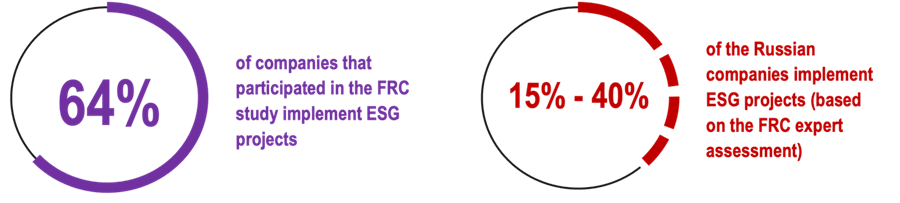
64% of companies that participated in the FRC study implement ESG projects. And almost all of them are large and medium-sized businesses that operate in conditions of high environmental and social risks. However, according to FRC expert assessment, the actual level of the Russian B2B enterprises operating considering ESG principles is significantly lower and is unlikely to reach 40%.
More than 2/3 of respondents of the FRC study said that the number of ESG projects in their companies has increased over the past two years. Almost a fifth of respondents reported no change in the number of ESG initiatives, and only 6% indicated a reduction.
Half of the companies have ESG principles embedded in their mission, and they influence their operational activities, while another 20% have them included in their business goals, which indicates a systematic approach. About 25% implement ESG projects selectively — in the form of individual initiatives, such as separate waste collection, clean-up days, or donor days.
"Today, ESG is understood more and more clearly in the Russian business - as a tool to increase investment attractiveness and maintain the value of resources in the long term, especially in the B2B segment. However, it is important to understand - who in the current business and geopolitical environment can plan and make investments with a return on the result after several business cycles? The study demonstrates this," comments Anna Shchepilova, PR Director of Metro Russia.
Among those responsible for making decisions on the need to implement ESG projects, three main groups of initiators can be identified: management or a special (usually collegial) body - 65%, one of the enterprise's divisions - 18%, and individual employees - 17%.
When speaking about the direct involvement of B2B company management in the discussion of ESG initiatives, we cannot help but note its important role. In approximately 40% of cases, business leaders themselves initiate ESG projects, and in another 40%, they support employee initiatives and proposals in the ESG field. In other companies, ESG projects are not prioritized, but at least they do not hinder such initiatives.
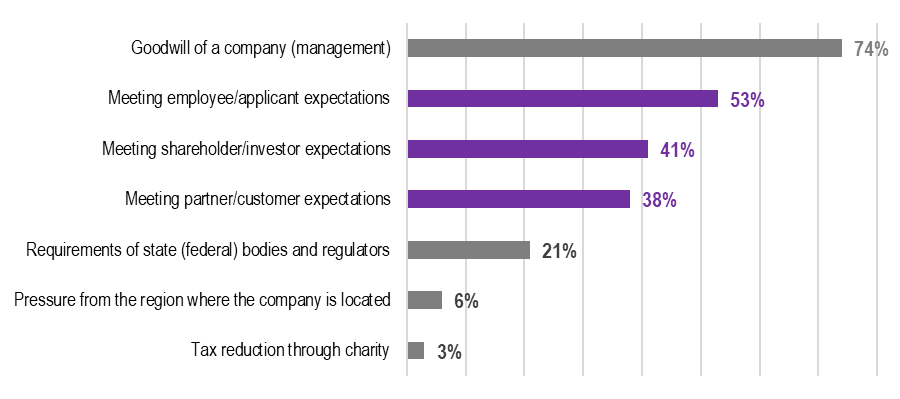
Most respondents (74%) cite the company's goodwill as the main reason for ESG initiatives. However, management may be driven by various motives. According to the data received, an important motivating factor is the desire to meet the expectations of their target audiences: employees/applicants, shareholders/investors, partners/clients (the immediate environment of the business).
In 2023-2024, the need for ESG communications increased for almost half (49%) of companies, remained at the same level for a third (34%), and decreased for only 6%. The B2B Russian market is slowly but surely moving towards increasing efforts in ESG communications.
"ESG projects today are not just internal company initiatives, but a full-fledged part of their own reputational capital. This is especially important for the B2B sector: customers, partners and even employees increasingly choose who to work with, focusing not only on financial and other conditions, but also on business values. Well-structured ESG communications help a company build trust, emphasize its openness and responsibility. This is an opportunity to show not only the result, but also the principles behind it. Such communication creates a stable image, promotes brand self-identification and makes it closer to those who share similar views," comments Maxim Gunishev, Head of Marketing and PR, SRG Group.
Talking about the key goals of their company’s ESG communications, most respondents (53%) name “following corporate culture relevant for a sustainable business/company”. At the same time, different companies may have more specific goals relevant for each specific business and related to current business tasks.
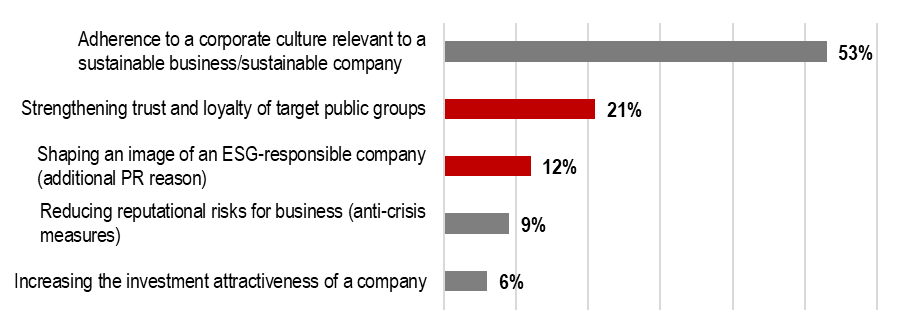
"Communication about ESG initiatives actually works for three important audiences of the B2B business - customers, partners and employees and helps to strengthen relations with key stakeholders. It is gratifying that the Russian B2B business notices this and shares this approach - and 49% of companies that point to the growing importance of sustainable development confirm this," says Olga Streltsova, Head of Marketing Communications at DHL Express in Russia.
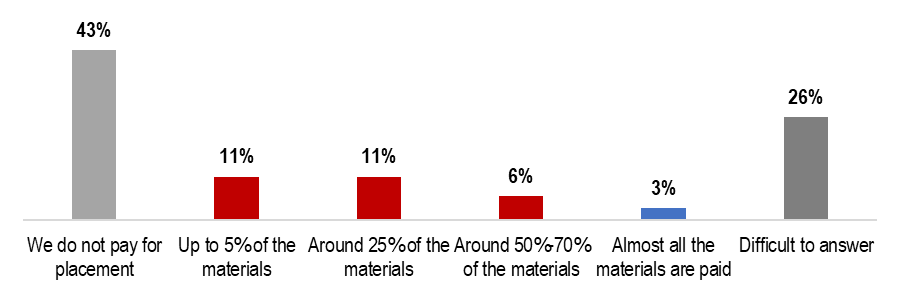
Only 30% of respondents pay for the placement of ESG materials, and only 3% almost always have paid ones. 43% place them exclusively on a non-commercial basis. This is explained by the lack of a separate budget for ESG communications - paid publications can only be financed episodically, from the Marketing or the PR department’s budget. Moreover, 2024 did not add resources: 55% of companies did not increase their budgets on ESG communications or even decreased, and only 11% increased investments in this area.
Companies view participation in the ESG awards and ratings to announce their achievements: 31% of respondents regularly or periodically use awards to communicate with the audience, and 40% consider participation in ESG ratings important. However, most companies do not participate in awards due to the lack of a visible effect (34%), budget (14%), or failure to meet requirements (11%). The situation is similar with ratings: a lack of funds, difficulty in participation, and the absence of a unified ESG strategy become obstacles.
Today, the main communication tool for ESG projects remains distribution of news and press releases to the media. About half of the respondents post expert and educational materials on various platforms and initiate publications in Telegram channels, less often in public pages on VKontakte.
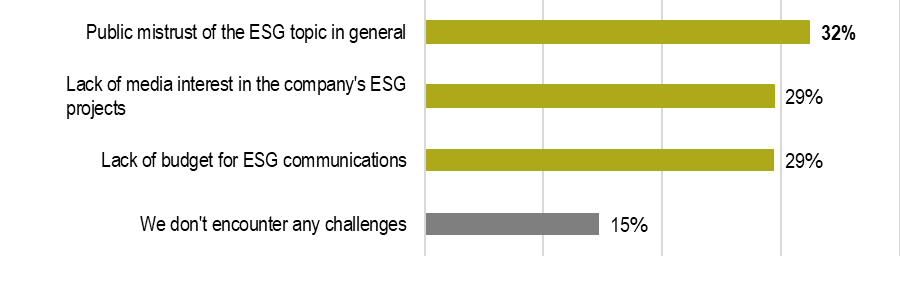
But what is holding back the advancement of ESG today? According to the FRC survey, the biggest challenge is public mistrust of the ESG agenda, noted by 32% of respondents. Readers and listeners who are already skeptical often perceive information about corporate ESG initiatives with prejudice and mistrust.
Another 29% of companies face lack of interest from the media, which makes it difficult to promote the topic in the public space. Another obstacle is the lack of a budget for ESG communications for 29% of the study participants. Financing is important, for example, for participation in awards and ratings, as well as for publishing materials in the media. These factors make ESG communications a complex, but strategically important task for business.
The future of ESG communications in Russia, according to most respondents, looks positive: 53% believe that the topic will develop and become the norm, the content will be more professional. About 30% believe that everything depends on external and internal factors - from the role of the state to the quality of data within companies. At the same time, 12% are pessimistic. They believe that public attention will be focused on other topics, and 5% found it difficult to predict.
“The future of ESG is institutionalization and maturity. The topics that were perceived as the “new black” and hype just a few years ago are now becoming part of the management norm. Ethics, manageability, and environmental friendliness are no longer a matter of choice, but a matter of maturity and consistency. The agenda is moving from the fashion stage to the stage of structures, roles, and processes. ESG is ceasing to be an external declaration and is becoming an integral part of the business management and public trust. At the same time, in the coming years, we will see a rejection of outdated approaches and an increase in the number of studies that will clarify which solutions are truly sustainable. What was considered the pinnacle of environmental responsibility three years ago, may turn out to be ineffective or even harmful today. ESG will be based not only on values, but also on evidence-based practice. New areas — digital security, AI, data management — will most likely be integrated into the ESG agenda, becoming its logical continuation. ESG will evolve: first, problems are born, then public interest is formed, then institutions and infrastructure. Everything goes in a spiral of maturity - and ESG has already entered the phase of systemic maturity," comments Anna Shchepilova, PR Director of Metro Russia.
When answering the question about the further interest of the Russian media in ESG topics, the majority (51%) note that we should expect an increase in the attention of national media to this agenda, 29% find it difficult to express a clear opinion, and 20% are pessimistic in this regard.
Key findings of the study:
1. ESG in B2B is no longer uncommon, but still not a mainstream: 64% of surveyed companies implement ESG projects, but the actual market involvement, according to expert estimates, is lower (ranging from 15 to 40%).
2. The ESG agenda is most often initiated by management: in 65% of companies, ESG projects are launched at the level of owners, CEOs or headquarters, and not by communications departments.
3. ESG communications are an extension of corporate culture: for most companies, ESG is not a PR move, but a reflection of internal values and an approach to sustainable development.
4. The main barriers are mistrust, weak media interest and lack of budget: ESG communications are limited by external skepticism, lack of funding and the media's unwillingness to talk about this topic.
5. 60% of companies do not have a separate budget for ESG communications, and 43% distribute materials for free.
6. The audience for ESG communications is the “business’s immediate environment”: employees, customers, partners, and suppliers are the main recipients of these messages.
7. The future of ESG is in adaptation to business realities and in the interests of younger generation: a transformation of practices towards integration with GR and further development on the wave of requests from generations Z and alpha are expected.
“Based on the study data and all the materials analyzed during its preparation, we can assume that ESG communications in Russia will go through a two-stage transformation in the next decade: first, there will be (already recorded) convergence with GR and “landing” of practices to the current tasks of Russian business; then – systematic development with a focus on the “zoomers” and “alpha” generations, who will have to decide the future of this area with the active mentoring of millennials”, sums up Ksenia Alexeeva, managing partner of the Fresh Russian Communications (FRC) agency.
About the respondents:
The study involved representatives of commercial B2B companies that are part of the professional community formed around the FRC agency. The respondents represent a wide range of industries: services (32%), industrial production and biotech (30%), IT and telecom (20%), as well as construction, trade and logistics. At the same time, 58% of companies work primarily in the B2B segment, the rest - in several segments, including B2C and B2G.
In terms of business size, both small and medium-sized companies (43%) and large enterprises ranging from 251 employees (57%) were represented. Most of the surveyed companies are not transnational corporations and conduct business primarily on the Russian market (58%), although 42% of respondents represent international brands. A total of 53 specialists took part in the survey, and 9 experts additionally provided their expert comments.
About Fresh Russian Communications:
Fresh Russian Communications (FRC) is a corporate and B2B communications agency. The agency's main specialization is PR & Marketing communications for the B2B companies and brands, consulting and projects in corporate social responsibility and ESG. The agency was founded in 2012, and is included in the TOP NR2K and the AKMR rating.
Follow us on Telegram, LinkedIn and X.